
 Written by Romeo Kuok
There is a familiar rhythm to market manias. They begin with a kernel of undeniable truth, accelerate with the arrival of retail capital, and typically end when leverage stretches the rubber band of valuation to its snapping point. Today, that rubber band is stretched tighter than ever, and the epicenter is not Wall Street, but Seoul.
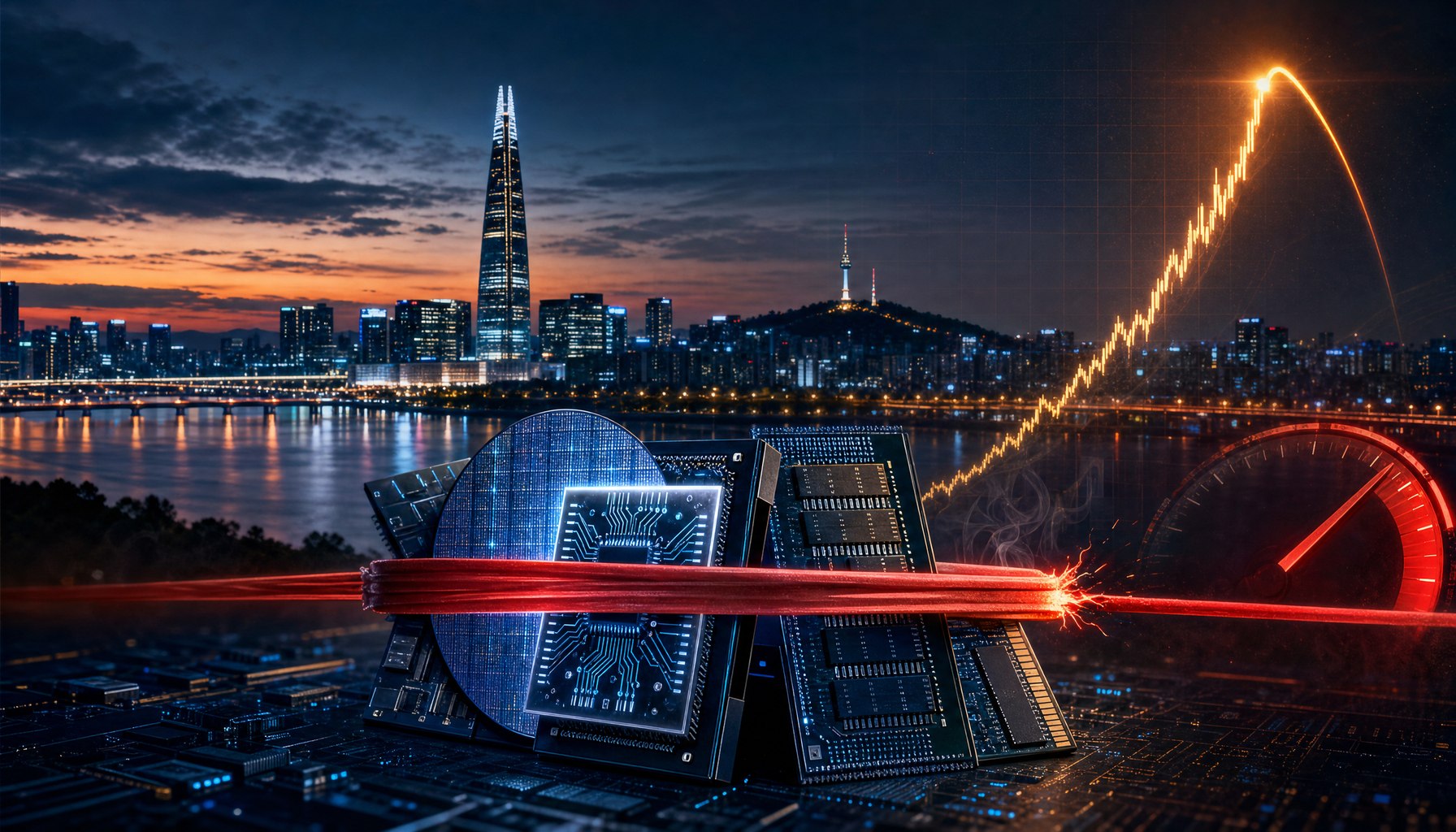
In recent months, a speculative fervor of historic proportions has gripped South Korean retail investors—affectionately known locally as “ants.” But these ants are carrying leverage that could crush the global semiconductor market. Assets under management (AUM) in South Korea’s leveraged exchange-traded funds (ETFs) have skyrocketed to a record $45 billion, marking an astonishing 800% surge since the start of 2026.
Even more alarming is the scale of this leverage relative to the underlying market. Leveraged exposure as a percentage of free-float market capitalization has reached a record 2.9%, more than tripling since January. To put this in perspective, when margin debt in the Chinese A-share market peaked in 2015, precipitating a devastating crash, it reached roughly 5% of free float. We are rapidly approaching a danger zone where the tail wags the dog.
The $15 Billion Gorilla in the Room
The most glaring manifestation of this phenomenon is the CSOP SK Hynix Daily 2x Leveraged Product (7709.HK), listed in Hong Kong. At its peak, this single-stock leveraged ETF amassed roughly $15 billion in assets, making it the largest single-stock leveraged product in the world.
To understand the sheer absurdity of this figure, consider the U.S. market. Four of the leading 2x leveraged long ETFs tracking global tech titans—Micron (MU), Nvidia (NVDA), Western Digital/Sandisk (WDC/SNDK), and Tesla (TSLA)—have never individually exceeded $10 billion in assets. Yet, a leveraged fund tracking a single South Korean memory chip maker dwarfed them all.
This concentration of leverage is fundamentally reshaping trading dynamics. The fund has grown so massive that its daily rebalancing operations—buying when the stock goes up to maintain leverage, and selling when it goes down—are driving volatility in SK Hynix shares, and by extension, the broader KOSPI index.
The Anatomy of the Mania
Why is this happening now, and why in South Korea?
First, there is the undeniable fundamental story. The artificial intelligence boom requires massive amounts of High Bandwidth Memory (HBM), a market where SK Hynix and Samsung Electronics are dominant players. SK Hynix shares have surged as earnings growth and AI demand have materialized.
However, this fundamental narrative has been hijacked by structural factors and a unique retail speculation culture. South Korean “ants” have a well-documented history of aggressive, momentum-driven trading. Facing a domestic real estate market that is out of reach for many young people and a desire for rapid wealth accumulation, retail investors have increasingly turned to high-risk financial products.
Furthermore, regulators inadvertently poured gasoline on the fire. While the Hong Kong-listed SK Hynix product was gathering billions, South Korean regulators approved a batch of domestic high-leverage single-stock ETFs in May 2026, partly to keep retail capital onshore. This backfired spectacularly. The domestic funds quickly amassed billions, drawing in retail investors despite mandatory risk-awareness tests.
The Mechanics of a Gamma Squeeze and Forced Liquidation
When leveraged exposure reaches 2.9% of a market’s free float, the mechanics of the market change. This is no longer about fundamental valuation; it is about plumbing and liquidity.
The primary risk is a forced liquidation cascade. Leveraged ETFs must rebalance daily. If SK Hynix drops significantly, the 2x ETF must sell shares to reduce its exposure and maintain its target leverage ratio. This selling pressure drives the stock price down further, forcing more selling the next day.
If this coincides with retail investors facing margin calls on their underlying brokerage accounts, the selling becomes indiscriminate. This creates a negative feedback loop—a fire sale that can quickly erase billions in market value. We saw a preview of this in late June 2026, when a sharp drop in SK Hynix and Samsung Electronics triggered a market-wide circuit breaker in Seoul, sending ripples through Nasdaq futures and global chip stocks.
Echoes of Bubbles Past
History is replete with examples of leverage-fueled market collapses.
Japan, 1989: During the Japanese asset price bubble, margin lending fueled a speculative frenzy that drove the Nikkei 225 to nearly 39,000. When the Bank of Japan tightened policy, the leverage unwound violently, leading to a multi-decade bear market.
The U.S. Dot-Com Bubble, 2000: Margin debt on the NYSE peaked alongside the Nasdaq. Retail investors, convinced that “this time is different” due to the internet, borrowed heavily to buy tech stocks. The subsequent crash wiped out 78% of the Nasdaq’s value.
China A-Shares, 2015: Perhaps the most direct parallel is the Chinese stock market crash of 2015. Shadow-financed margin accounts and explosive retail leverage drove the Shanghai Composite up over 150% in a year. When regulators attempted to rein in the leverage, a brutal fire sale ensued, causing the market to lose 30% of its value in a month.
In all these cases, the fundamental catalyst (Japan’s economic miracle, the internet, China’s growth) was real, but the leverage turned a bull market into a systemic risk.
The Verdict: Navigating the Minefield
The current situation in South Korean tech stocks is precarious. The underlying companies are excellent businesses, but the market structure surrounding them has become dangerously unstable. Investors must separate the company from the stock, and the stock from the leveraged derivatives driving its price.
Here is our current outlook and ratings for the key players caught in this crossfire:
| Stock / Asset | Ticker | Rating | Target Price / Outlook | Rationale |
| SK Hynix | KRX: 000660 | HOLD | KRW 2,600,000 | The AI memory story is intact, but the stock is held hostage by the $15B leveraged ETF. The risk of forced liquidation cascades outweighs near-term upside. Wait for the leverage to flush out before adding. |
| Samsung Electronics | KRX: 005930 | BUY | KRW 400,000 | While exposed to the ETF contagion, Samsung’s broader business mix provides a better margin of safety. Current weakness presents a buying opportunity for long-term holders. |
| Micron Technology | NASDAQ: MU | BUY | $165.00 | Strong fundamentals in memory pricing and less exposure to the specific Korean retail ETF dynamics. A safer play on the memory cycle. |
| Nvidia | NASDAQ: NVDA | BUY | $155.00 | The undisputed king of AI silicon. While not immune to global tech selloffs, its structural dominance and cash flow generation make it a core holding on any dip. |
| Western Digital | NASDAQ: WDC | HOLD | $85.00 | Benefiting from the memory cycle, but highly cyclical. Fairly valued at current levels. |
| Tesla | NASDAQ: TSLA | SELL | $180.00 | Facing increasing EV competition and margin compression. The current valuation relies heavily on unproven autonomy promises. |
| CSOP SK Hynix Daily 2x Leveraged ETF | HKG: 7709 | SELL | N/A | Extreme structural risk. This product is a trading vehicle that has grown too large for its underlying market. Avoid entirely. |
| Direxion Daily MSCI South Korea Bull 3X (KORU) | NYSEARCA: KORU | SELL | N/A | A 3x leveraged product in a market already suffering from leverage indigestion is a recipe for catastrophic capital destruction. |
The 800% surge in Korean leveraged ETF AUM is not a sign of a healthy bull market; it is a klaxon warning of structural fragility. When the leverage unwinds—and it always does—the damage will not be confined to the “ants” in Seoul. Global tech investors must tread carefully.